Posted on Leave a comment

Buy or Build?

red cart for selling street food

Let’s talk about what and why (and we’ll defer how to a later post).

What to grow depends entirely on the specific factors/outcomes that you want to achieve. The three applications / uses that stand out to me are fragrance, culinary, and cut flowers. If you rely entirely on the garden center, you will have a beautiful and likely expensively cultivated garden that should produce consistent results with minimal effort, meaning all you need to do is pick a spot for your flowers and plant.

But, many gardeners augment garden center flowers with cultivated (i.e., self-grown) flowers that are not available at the local five and dime store. This is because the big box stores travel in high-volume circles and only sell proven fast movers. But, if you desire something more, i.e., differentiation, from your neighbors who probably frequent the same shops, you may have to put your back into it. I look for inspiration pictures in magazines, on Pinterest and Instagram, and other seed and bulb catalogs. I also take lots of pictures when I travel of gardens / flowers that turn my head.

Specific Considerations for Flower Selection:

1. Fragrance is an output of many flowers, including roses, lilacs, and plumeria. But not all roses have a fragrance and certainly neither do all flowers. When I’m shopping for roses, some of the specific attributes that I consider are the appearance/shape of the blossom, color, bloom size, stem length, and fragrance. It’s not always easy to get everything you want in a single cultivar, but an assembly of varieties planted together can look and smell amazing. I have more than 100 different roses (including rose trees) in my collection.

2. It goes without saying that vegetables and herbs are edible, but so are many flowers. It may sound foreign to eat a flower, but if you toss one into a salad think of all the benefits. They look lovely and can add a hint of flavor (beyond the intrinsic health benefits). Some of my favorites include nasturtium, pansies, and calendula. But don’t be afraid to try new things, risks taken will be rewarded and you will look like a five star (or at least sophisticated) cook to all of your friends when you use them. I suggest you Google the specific variety to find out whether its edible before you take your first bite or, better yet, before you buy it….

3. I already mentioned that stem length is core to my formula. I take cut flowers from my garden all summer. Some gardeners have a specific dedicated space filled with flowers designated for cutting. If you’re not as formal (like me), if you plant enough, there will be plenty to cut without bare spots (if you cut carefully). Some of my favorite cuts are from peonies, tulips, and alliums in the spring; purple cone flowers in early summer; and zinnias and cosmos are work horses during mid- and late-summer that produce week after week. I’ve read that sweet peas are awesome and smell amazing, but I failed miserably last spring at growing them. (They are on the list again for this year, so I will have to let you know how it goes.)

The ”todo” this week (if you are building out your garden roadmap along with me) is to conduct research for inspiration pieces and identify flowers that you would like to incorporate into your garden plan. Take notes and screenshots to ensure you don’l lose track of your finds…

If you enjoyed reading this blog, please subscribe to continue receiving updates from the farm.
Posted on Leave a comment

Season Extension

The cold Chicago weather has me thinking about season extension, which simply means growing plants outside the parameters of one’s growing environment or season. One thing that always resonates with me when visiting other regions are the beautiful flowers that I can only dream of at home this time of year. In fact, I happily spend hours every winter surveying flower magazines for inspiration (and sometimes curse when west coast growers post pictures on Instagram of their flourishing gardens, not withstanding…)

Chicago weather is very temperamental and, as such, it’s extremely risky to plant anything outside before June 1. (I attribute it to Jack Frost’s frequent visits throughout the spring months and inability to contain his wily ways.) But, waiting until June to start planting (whether flowers or veggies) will delay any substantial presence in the garden. Also, most natural color outside is fleeting in the fall when the leaves abandon the trees and the frost kills off any straggler plants after a mere three to four short months.

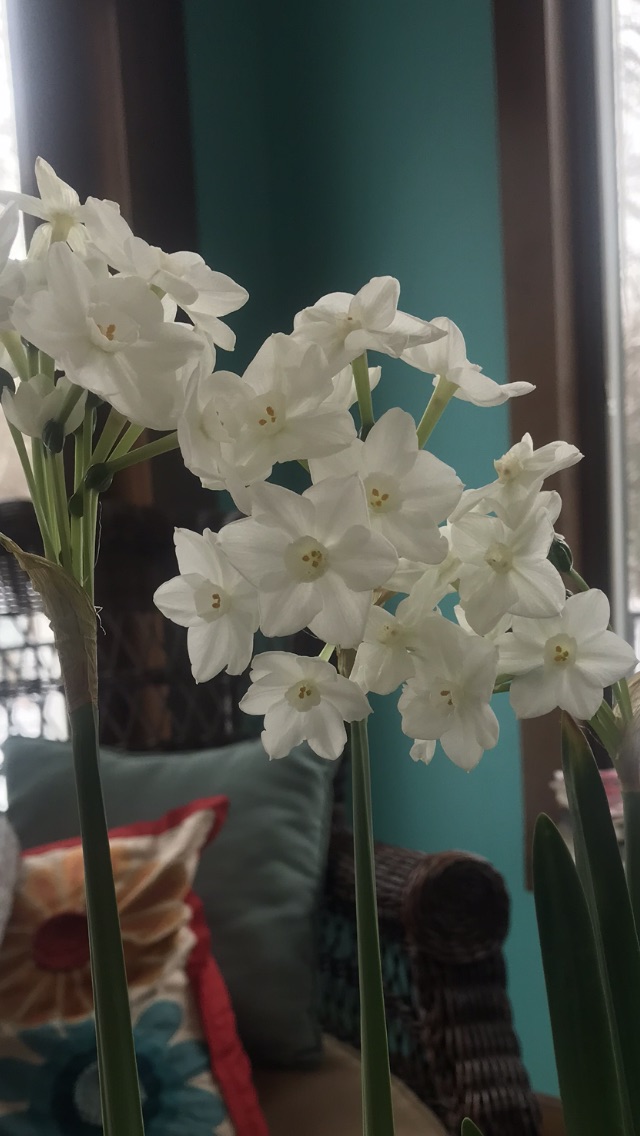
The way through this quandary is not to flout Mother Nature (because she always wins), but to consider potential workarounds such as growing in containers and/or growing inside. While there are many options, this year I planted approximately 100 ziva paperwhites ‘narcissus papyraceus’ bulbs inside and have been amazed by how beautifully they have flourished.

Growing Indoors in Containers

The process begins with identifying the plant you want to grow. We planted three bulbs in a 6 inch container and then watered them for about 4-6 weeks. The bulbs produce long sleek green stems with clusters of white flowers that bloom for weeks. (Mine grew to about 21.5 inches tall from the top of the container). They also produce a beautiful fragrance that lingers in the air, which I immediately notice when I enter the room. These flowers are light and fresh and offer a welcome hint that spring is just around the corner (when it is needed the most). Also, starting one’s own plants and watching them grow is extremely satisfying.

Paperwhite bulbs are easy to grow in containers and bloom by Christmas, often into January. As an added bonus, the bulbs can be saved/stored (in a cool dry place) after the stems die back and will produce even more flowers next year.

Listed below are a few tips and tricks for successful growing indoors in pots:

  1. Soil mediums are key. When growing in containers, its important to use a light soil medium to support strong and healthy root development. Many growers use a mix of peat, perlite, and vermiculite. But, I personally like the coco coir and Nature’s Cure organic mixes. (Potting soil should be avoided because it is too heavy.) Note, the root system, plant leaves, and sun light are all essential success factors for heathy plant development.
  2. Choose bulbs that have demonstrated success growing indoors and in containers. Bulb size can often indicate how many flower shoots may be generated by an individual bulb. Also, certain bulbs have prooven performance as perennials while others are one and done. Perennials, which by definition come back for at least three consecutive years, are a good investment. (Google your particular cultivar/variety to understand these key considerations).
  3. Don’t forget to water your flowers regularly, but don’t overwater. Research your specific plant’s water requirements.
  4. If the stems get long and top heavy, you could also consider staking them or cutting and displaying them as a cut flower arrangement in a simple vase.

We hope you found this information useful. Subscribe to our blog to receive updates from our flower farm.

Posted on Leave a comment

Mastering the Art of Gardening in 365 Days

white petaled flowers

Italo Svevo once said, change is unsettling “just as liquid in a jar turns cloudy when you shake it.”

Starting a garden is scary. Especially if you think that you may be suffering from the nefarious, albeit self-diagnosed, condition “black thumb”. But, it is often the things that make our hearts pound with fear (when we think about doing them) that are ultimately the most rewarding. I started this blog to chronicle lessons from the Le Pommier flower farm and hope that our open kimono format will help others realize their own gardening goals.

I took up gardening several years ago when my son became ill as a way to refocus my attention away from the things that were outside of my control and that were overwhelming me at the time. (I also went back to graduate school to finally get that MBA and took the Illinois Master Gardener’s Training course. I would have done anything to keep myself busy and escape my troubles). But, in doing so, I was able to find nuggets of peace in unexpected ways and have made so many amazing connections with people who share my passion for growing and/or are dealing with loss or the challenges of caring for a loved one as well.

Whatever your motivation, if you are reading this post, it is likely that you share a passion for gardening and are looking for some tools and/or information to help you along your journey. Join us as we endeavor to unlock the mystery around gardening and to master its art form in just 365 days. We will document our journey here and provide information about different plant varieties and cultivars to help get the juices flowing.

As a starting point, during January we will focus on building out the Garden Roadmap and documenting the major considerations for successful growing. Provided below is short checklist of items to consider when planning your garden. We hope you find this information useful.

Getting Started – The Garden Plan Checklist

  1. Set your intention: What are you passionate about? e.g., think about whether you can get excited about growing vegetables and/or herbs, and if flowers excite you.
  2. How big of a space do you have to dedicate to this project? If you are new to gardening, you may want to start with a 4 X 6 foot plot or smaller. Garden pots on a porch or balcony work too. (All consider that some towns have community gardens where individuals can rent small garden plots).
  3. Where is the space located? Front or back yard. Be specific.
  4. Is your location sunny or shady. If sunny, how many hours of sunlight does your location get daily?
  5. What gardening tools do you currently have? e.g., garden gloves, hand spade, pots, etc.
  6. How will you water your garden? e.g., hose, sprinkler, manually?
  7. How many hours per week will you commit to this project? (Can you dedicate 30 – 60 minutes per day)?
  8. What is your USDA plant hardiness zone? (This will determine which plants can be successfully grown in your area). See https://garden.org/nga/zipzone/.

Subscribe to our blog at https://le-pommier.org to continue receiving updates from the farm.